Showing posts with label STYLE in architecture. Show all posts

Thursday, July 14, 2011

ART nouveau

Introduction
Art Nouveau was an innovative international style of modern art that became fashionable from about 1890 to the First World War. Arising as a reaction to 19th-century designs dominated by historicism in general and neoclassicism in particular, it promulgated the idea of art as part of everyday life. Henceforth artists should not overlook any everyday object, no matter how functional it might be. This aesthetic was considered to be quite revolutionary and new, hence its name - New Art - or Art Nouveau.

Saturday, June 25, 2011

DECONSTRUCTION in ARCHITECTURE

In the 1980's a new tendency was born: the deconstruction, which was also called "new modern architecture" in its beginning. It was meant to replace post modern architecture. A very significant difference of this style is that it started rather from an intellectual movement than from a significant building marking it's beginning. The new slogan was "form follows fantasy" analogous to the tradition formula pronounced by Sullivan "form follows function". In 1988 Philip Johnson organized an exposition called "Deconstructive Architecture" which finally brought these ideas to a larger audience. Those ideas even had a philosophical base developed by Jacques Derrida.

Monday, June 20, 2011

The DEATH and RESURRECTION of postmodern architecture

It is obvious to anyone interested in contemporary architecture' that the last ten or fifteen years have been a time of tremendous ferment, energy, and above all confusion for this most public of the arts. While a handful of star architects continue to bask in glamour and celebrity, there is widespread suspicion that the profession as a whole is in disarray. The carousel of architectural “styles” that one has seen whiz past with dizzying rapidity, the succession of pretentious, aggressively mediocre buildings that litter our cities' skylines, the plethora of arcane theories advanced to “explain” every conceivable species of architectural practice—all this has left the world of architecture a bit stunned and uncertain where to turn for direction. The confident rise of postmodernism in the Seventies and early Eighties has been succeeded by a period of doubt and reassessment. Not that there is much indication that the paraphernalia of postmodernism is losing popularity. On the contrary, postmodernist grandiosity remains the order of the day among most corporate clients and ambitious homebuilders hoping to make an architectural “statement.” But neither architects, nor their clients, nor the public at large seem quite so sure these days that the answer to the much publicized failings of modernist architecture is to be found in skyscrapers bedizened with Chippendale tops and pastel facades, or in houses decked out with pseudo-Palladian windows and slapdash historicist ornamentation.

Wednesday, June 15, 2011

ARCHIGRAM: Architecture without Architecture

In the 1960s, the architects of Britain's Archigram group and Archigram magazine turned away from conventional architecture to propose cities that move and houses worn like suits of clothes. In drawings inspired by pop art and psychedelia, architecture floated away, tethered by wires, gantries, tubes, and trucks. In Archigram: Architecture without Architecture, Simon Sadler argues that Archigram's sense of fun takes its place beside the other cultural agitants of the 1960s, originating attitudes and techniques that became standard for architects rethinking social space and building technology. The Archigram style was assembled from the Apollo missions, constructivism, biology, manufacturing, electronics, and popular culture, inspiring an architectural movement—High Tech—and influencing the postmodern and deconstructivist trends of the late twentieth century.

still about ARCHIGRAM

The phenomenon that is Archigram (from ARCHItecture and teleGRAM) changed the world of architecture in the sixties and seventies and has influenced many world class, and less famous, architects - and architecture generally - ever since. Indeed the group's ideas have grown even more relevant as time passes. 1991 saw the reissue of the book that they put together in 1972, and the Archigram exhibition has been touring the world since 1994.

ARCHIGRAM architecture

Walking City in New York, 1964
ARCHIGRAM dominated the architectural avant garde in the 1960s and early 1970s with its playful, pop-inspired visions of a technocratic future after its formation in 1961 by a group of young London architects – Warren Chalk, Peter Cook, Dennis Crompton, David Greene, Ron Herron and Michael Webb.

Monday, June 6, 2011

BAUHAUS

A brief history of the German Bauhaus school of industrial design

Saturday, June 4, 2011

MODERN ARCHITECTURE

facts......
Modern home architecture officially kicked off in southern California with the introduction of The Case Study House Program in 1945 in "Arts and Architecture" magazine. 

post MODERN ARCHITECTURE____

how TO RECOGNIZE POST MODERN

Familiarize yourself with historical architectural styles to appreciate the post-modern era that began in the late 1970s and continues today. Post-modern architecture mixes and matches architectural styles in innovative, non-traditional combinations seen in today's building style. Recognize and appreciate it by learning the architectural styles of yesterday. Read on to learn more.

post MODERN ARCHITECTURE___

influential ARCHITECTS

McCormick Tribune

post MODERN ARCHITECTURE__

the Vanna Venturi house
Robert Venturi was at the fore­front of this move­ment. His book, Complexity and Con­tra­dic­tion in Architecture (pub­lished in 1966), was in­stru­men­tal in open­ing read­ers eyes to new ways of think­ing about build­ings, as it drew from the en­tire his­tory of architecture – both high-style and ver­nac­u­lar, both his­toric and modern – and lam­basted overly sim­plis­tic Functional Modernism. 

post MODERN ARCHITECTURE_

RELATIONSHIP to previous STYLE
New trends be­came ev­i­dent in the last quar­ter of the 20th cen­tury as some ar­chi­tects started to turn away from mod­ern Functionalism which they viewed as bor­ing, and which some of the pub­lic con­sid­ered un­wel­com­ing and even un­pleas­ant. 

post MODERN ARCHITECTURE

Harold Washington Library, Chicago

Postmodern architecture began as an in­ter­na­tional style the first ex­am­ples of which are gen­er­ally cited as being from the 1950s, but did not be­come a style until the late 1970s and con­tin­ues to in­flu­ence present-day architecture. Postmodernity in ar­chi­tec­ture is said to be her­alded by the re­turn of »wit, or­na­ment and reference« to ar­chi­tec­ture in re­sponse to the for­mal­ism of the International Style of mod­ernism. As with many cul­tural fash­ions, some of Postmodernism's most pro­nounced and vis­i­ble ideas can be seen in ar­chi­tec­ture. The functional and for­mal­ized shapes and spaces of the modernist style are re­placed by di­verse aesthetics: styles col­lide, form is adopted for its own sake, and new ways of view­ing fa­mil­iar styles and space abound. Per­haps most ob­vi­ously, ar­chi­tects re­dis­cov­ered the ex­pres­sive and sym­bolic value of ar­chi­tec­tural el­e­ments and forms that had evolved through cen­turies of build­ing which had been aban­doned by the mod­ern style.

Friday, June 3, 2011

CUBISM

BREUER
The aesthetic movements of the early 20th century were frequently and closely connected with new ideas in architecture. Futurism, the Dutch group De Stijl, the purist manifesto of Le Corbusier and Ozenfant, Suprematism and Constructivism in Russia, and Expressionist German painting resonated with the development of modernist ideas and forms in architecture. However, the question of the relationship of Cubist painting and sculpture to architecture is not straightforward. Rather, Cubism was a point of departure, contributing to the development of new concepts in Modern art. 

still about BRUTALISM in ARCHITECTURE___

Brutalism (also called New Brutalism), narrowly defined, was the term used to describe the theory, ideas, and practice of a small number of young architects in Great Britain from 1950 to 1960. Broadly conceived, Brutalism came to describe an international approach to architecture that reflected social ideals, industrial and vernacular means, and humane goals.

Brutalist classic: A housing complex in Montreal by Moshe Safdie

ART DECO architecture

CHRYSLER BUILDING
The term Art Deco is a now firmly established designation for an aesthetic of the late 1920s and 1930s that in its own day was called art moderne. In architecture, the style took various forms, each of which has prompted historians to devise different identifying terminology. In the 1960s, the more ornamental phase of popular modernism was dubbed Art Deco, echoing the name of the 1925 Parisian Exposition des Arts Decoratifs et Industriels Modernes, where the style’s formal design motifs, patterns, and decorative predilections were first observed. Recognizing in Deco a character both modern and abstract but a style that nevertheless avoided the white, volumetric, and planar reductivism of the emerging 1920s “Bauhaus Modern,” some historians referred to the style as “modernistic,” that is, pseudomodern or approaching modern. These and other design terms and stylistic labels have been applied to the several dimensions of Art Deco architecture after the mid-1920s.

Thursday, June 2, 2011

ART DECO architecture

The Dawn of Deco: History of Art Deco Architecture

These were the buildings of the future: sleek, geometric, dramatic. With their cubic forms and zigzag designs, art deco buildings embraced the machine age. Yet many features of the style were drawn not from the Jetsons, but the Flintstones. 

Wednesday, June 1, 2011

the DEATH of MODERN ARCHITECTURE_

For those interested in the philosophical side of architecture, Chad Friedrich’s new documentary The Pruitt-Igoe Myth appears to be a fascinating look into the infamous housing project Pruitt-Igoe in St. Louis, Missouri — once the heart of the public housing debate and commonly referred to as a failure of modernist architecture.

the DEATH of MODERN ARCHITECTURE

Just as history in Fukuyama's death of history, modern architecture is coming back form the other world. The thing is that in both cases there were false burials. In both the media contributed greatly in building a new utopia: post-history and post-modernity were sophisticated ways of being inside history and modernity. Modern utopia, which has always been the enemy of modern refexive creativity, as it turns into collective what is strictly individual, is behind the political burial of modern architecture. 

Saturday, May 28, 2011

MODERN EXPRESSIONISM

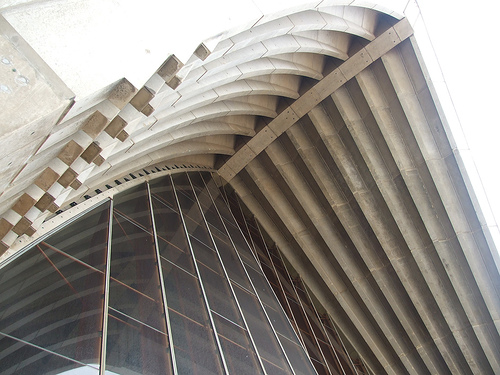
Sydney Opera House

Modernist architecture has these features: little or no ornamentation, factory-made parts, man-made materials such as metal and concrete, emphasis on function, and rebellion against traditional styles.